


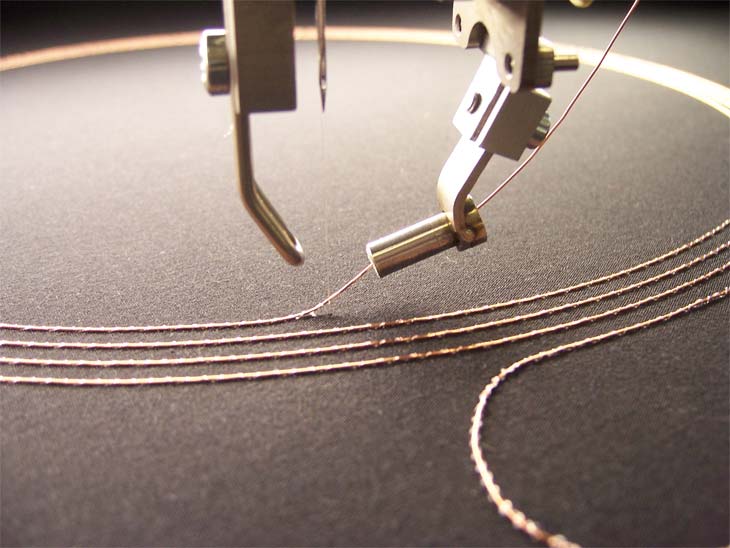
Embroidered heating elements: heated textiles with Tailored Wire Placement
ZSK W-heads lay heating wire onto fabric, nonwoven, mesh or foil in exactly the pattern your heating power needs – for seat and steering wheel heating, heated clothing, blankets and industrial heaters, from sample to multi-head series.
What is an embroidered heating element?
An embroidered heating element is a resistive heating wire that a ZSK W-head lays onto a flexible carrier in a programmed pattern and fixes with a zigzag stitch. Because the layout is free, wire density – and with it the heating power – can be distributed exactly where warmth is needed, and components such as thermoswitches can be integrated. The process is known as Tailored Wire Placement (TWP) and is well established in automotive seat heating.
Where are embroidered heating elements used?
Wherever heat must be flexible, flat and placed precisely – often invisible under leather or fabric.
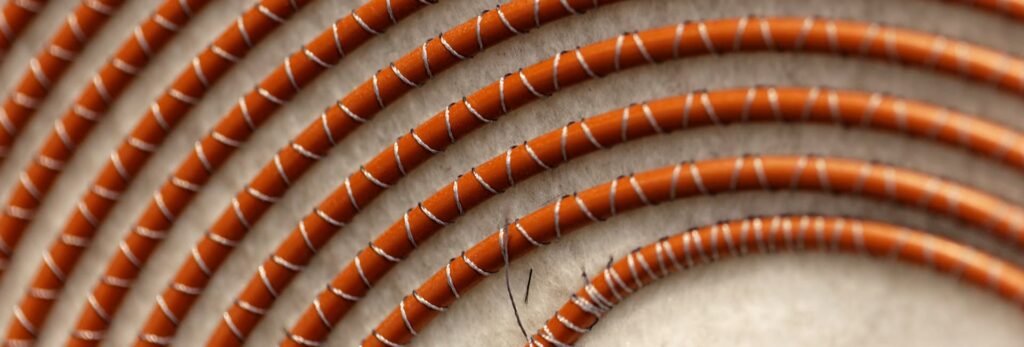
The classic: heating wire on a carrier, fixed with zigzag stitches, invisible under leather and fabric. Automotive & interior →
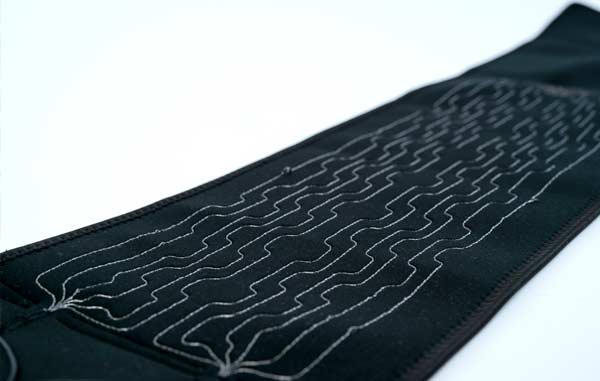
Heating systems for garments and workwear; embroidered coils also create magnetic fields for therapy mats and belts.
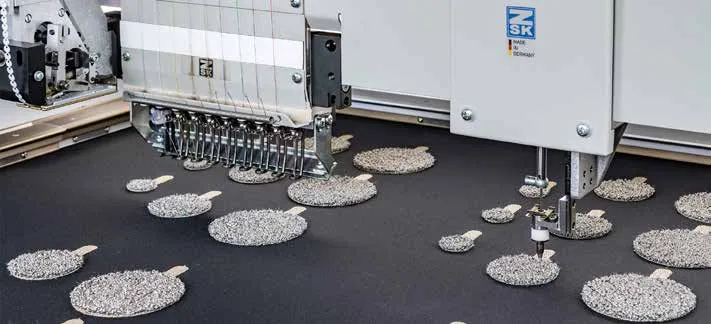
Embroidered heating elements spread warmth evenly at low voltage – suitable for direct contact.
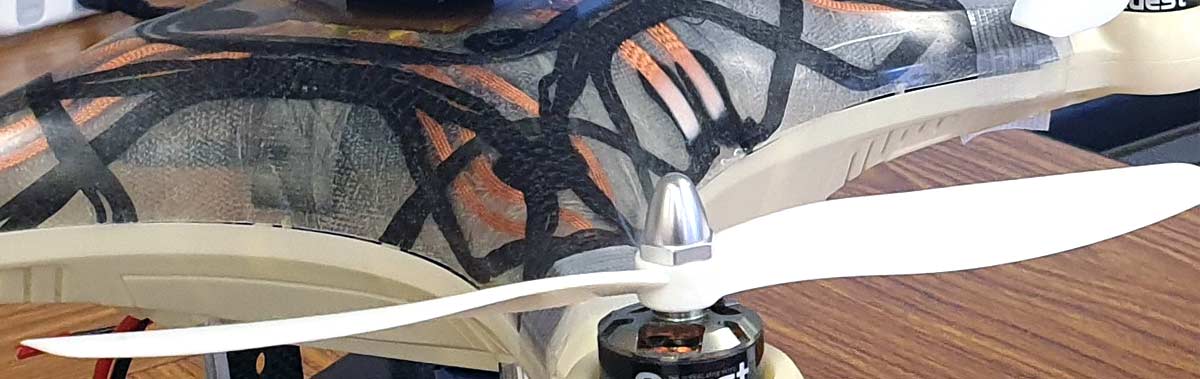
Heating wires laid into TFP preforms keep drone parts and roof structures free of ice. TFP for drones →
Wires or tubes embroidered into flat textile heating and cooling mats.
Industrial heating applications, home appliances and comfort systems.
Tailored Tube Placement routes warm or cold fluid – e.g. heat exchangers in roof structures or cooling garments.
How is a heating wire embroidered?
Design, lay, check, connect – all controlled by the embroidery programme.
- 01 LAYOUT
Wire pattern and heating power distribution designed in the embroidery software
- 02 CARRIER
Fabric, nonwoven, mesh or foil clamped in the frame
- 03 FEED
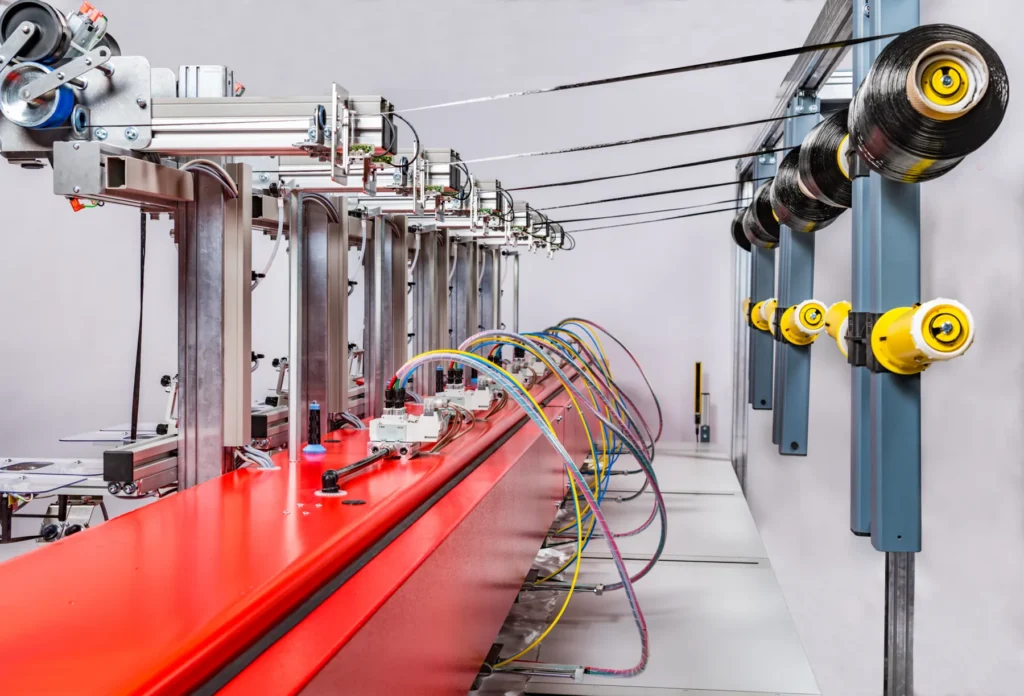
Active wire supply from rolls of up to 10 kg
- 04 LAY & FIX
W-head lays the wire and fixes it with a zigzag stitch
- 05 CHECK
Wire-hit and end-of-wire detection, pneumatic cutter
- 06 INTEGRATE
Thermoswitches and connections; continuous lengths via Roll2Roll
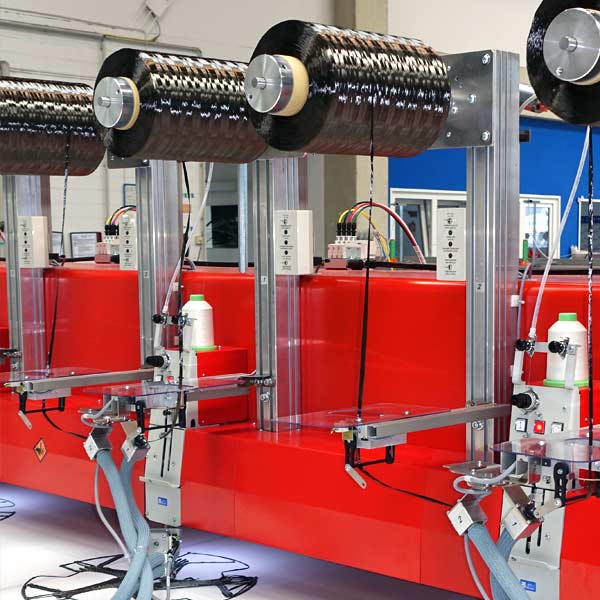
Which heating wires can be embroidered?
Stainless steel, copper, coated wires, optical fibre cable and hybrid wires such as stainless steel with PES can be laid, from 0.07 to 6 mm in diameter. Coatings such as enamel or PVC are not affected by the embroidery process. Depending on the stitch technique, the wire is fixed tightly or keeps a little play and stretch.
Double wires can be placed in parallel or at a defined distance of 1–5 mm (wider on request).
Built for volume – and for zero defects.
Heated seats are produced in very high volumes, so the machine must run long and detect faults itself. If the needle hits a laid wire, wire-hit detection stops the machine and shows the affected head; the part can be marked for removal – a function that is mandatory in many industries, such as heated car seat production.
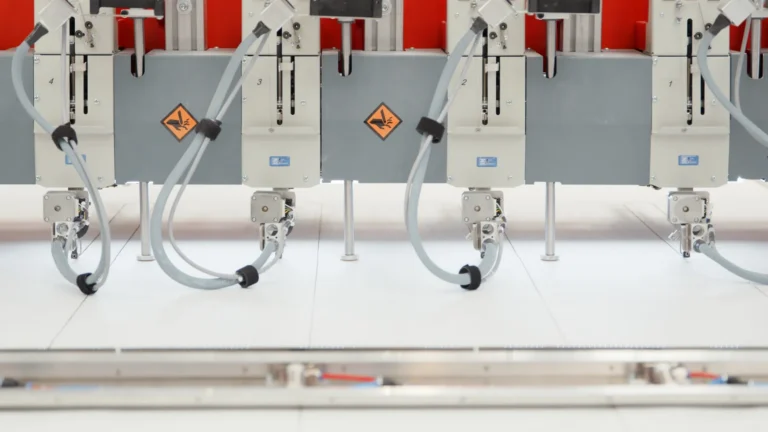
- 8- or 10-head machines place 8–10 large heating elements at once; up to 20 heads for small parts
- Laying fields from 600 × 400 mm to 3,000 × 2,100 mm; up to 7,200 × 3,000 mm with automatic head selection
- HV-TWP (with Nobrak SAS): parallel placement of up to 3 media for higher volume
- Automatic bobbin changer with 8-bobbin magazine and large-capacity hook for long runs
- Roll2Cut and Roll2Roll pull-through: almost endless fields with the electrical connection on one side
Smart heating: control electronics and training
A heating element needs control. Embroidery can integrate that too.
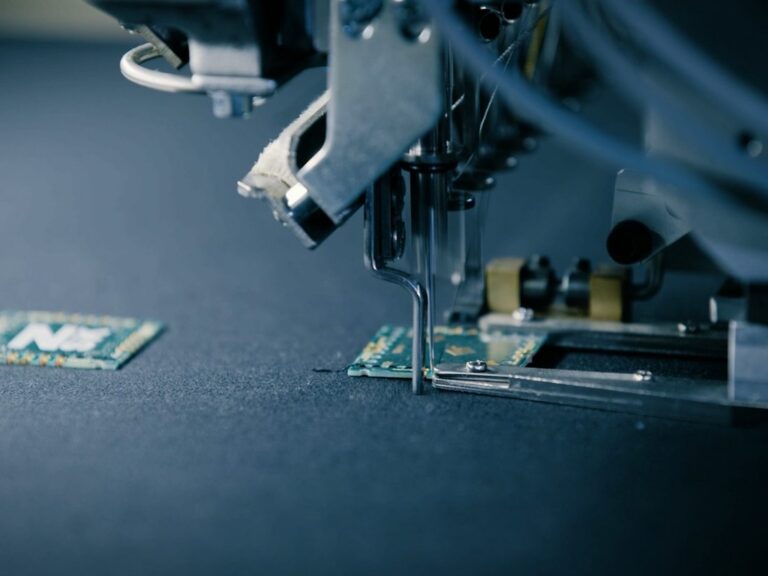
The EP-30 places, fixes and contacts the PCBs for intelligent heating systems in workwear and protective clothing. EP-30 →
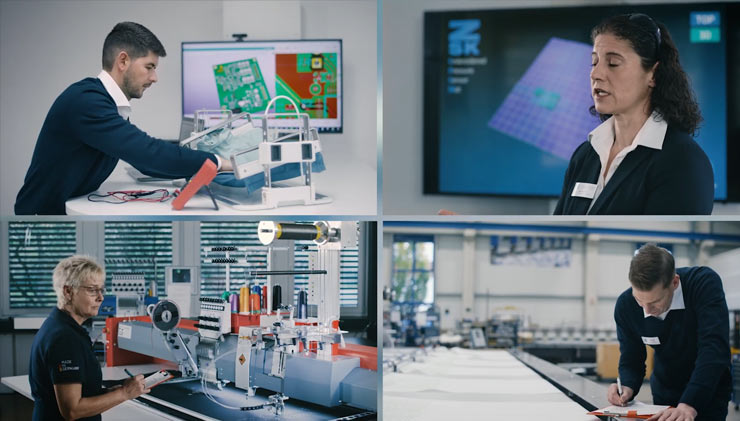
Hands-on training and prototyping for heated textiles by the ZSK engineering office. Workshops →
Combine heating wires with temperature, moisture or stretch sensor wires in the same embroidery run. Smart textiles →
More on wires and functional textiles
Your heating layout. Embroidered in series.
Send us your heating element, wire and target power – we lay samples, check the process and configure the machine for your volume.
Questions about embroidered heating elements
Short answers for product developers and production planners. Missing your question? Our engineers answer personally.
How are heating elements made by embroidery?
With Tailored Wire Placement (TWP): a ZSK W-head feeds a resistive heating wire to the carrier and fixes it with a zigzag stitch while the frame moves along the programmed path. Fabric, nonwoven, mesh or foil can serve as carrier. The free layout lets you distribute heating power exactly where it is needed and integrate components such as thermoswitches.
Which wires can be used for embroidered heating?
ZSK machines lay stainless steel, copper, coated wires and hybrid wires such as stainless steel with PES, with diameters from 0.07 to 6 mm. Wires can be uncoated or coated with plastics, rubbers or elastomers; coatings such as enamel or PVC are not affected by embroidery. Thicker coated heating wires have also been routed in controlled geometries.
What is wire-hit detection and why does it matter?
If the needle hits an already laid wire, the ZSK machine stops automatically and identifies the affected laying head. The defective part can then be marked for removal. This function is mandatory in many industries, for example in the production of heated car seats, because a damaged heating wire must never reach the customer.
Can embroidered heating elements be produced in high volumes?
Yes. For relatively large elements, 8- and 10-head machines place 8 to 10 parts at the same time; for smaller parts ZSK builds machines with up to 20 heads. Large wire rolls of up to 10 kg, automatic bobbin changers and Roll2Roll or Roll2Cut pull-through systems keep the machines running continuously.
Can heated clothing be embroidered?
Yes. Wire routing for heated clothing is a common Tailored Wire Placement application, for jackets, belts and therapy pads, and heated dog blankets use low-voltage embroidered elements. The EP-30 can additionally place the control electronics for intelligent heating in workwear, and 3E Smart Solutions offers workshops on heated textiles.
Which ZSK machine do I need for heating elements?
Any ZSK machine with W-head can lay heating wire. Prototyping and small series run on single-head or combination machines, for example with the inside layer motor for small rolls; series production uses multi-head machines with active wire supply, wire-hit detection and optional pull-through automation. ZSK configures the system for your element size and volume.
Technical data: Tailored Wire Placement for heating elements
| Parameter | Value |
|---|---|
| Wire / tube diameter | 0.07–6 mm |
| Wire types | stainless steel, copper, coated wires, optical fibre cable, hybrid wires (e.g. stainless steel + PES) |
| Carriers | fabrics, nonwovens, meshes, foils |
| Media per head | automatic switching of up to 4 media (patented) |
| Double wire spacing | 1–5 mm, wider on request |
| Wire supply | 4 large rolls up to 10 kg per roll, twin active supply units |
| Safety | wire-hit detection, end-of-wire detection, pneumatic wire/fibre cutter |
| Heads per machine | 1 to 20 |
| Laying field | 600 × 400 mm to 3,000 × 2,100 mm; up to 7,200 × 3,000 mm (21.6 m²) with head selection |
| W-head speed | up to 850 rpm |
Sources: ZSK TWP/TTP brochure 2026, knowledge base 05/2026, white paper “A Guide to Technical Embroidery”. Depending on configuration. Subject to change.