


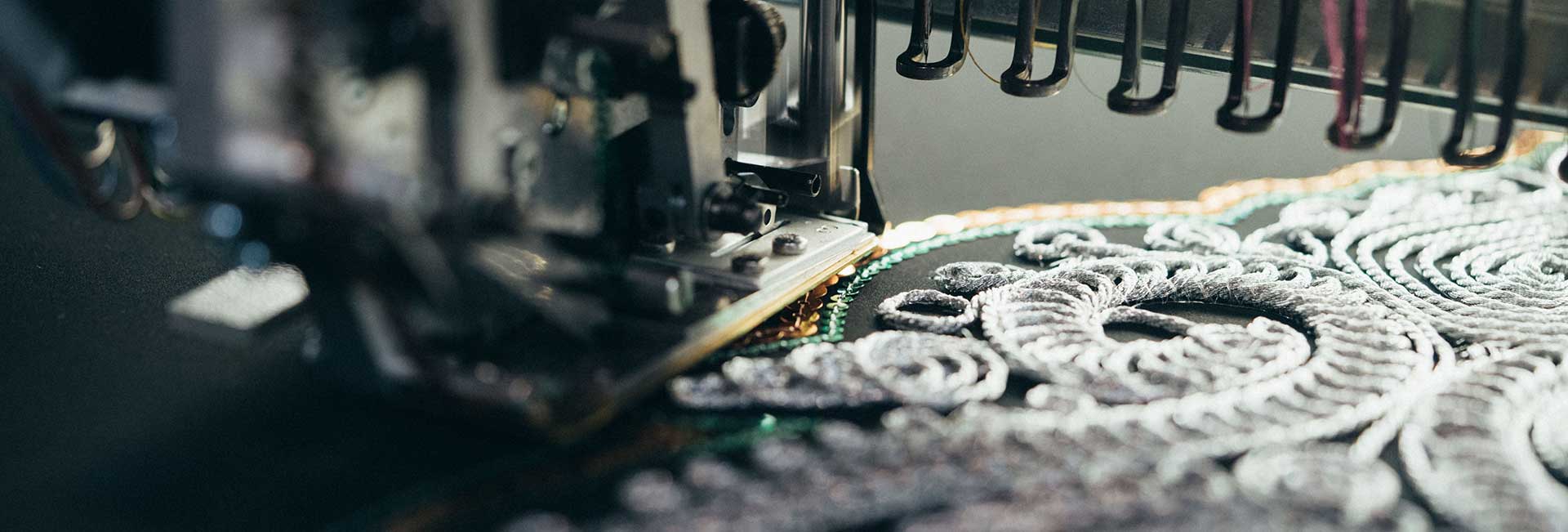
Sequin, bead and cording devices for embroidery machines
Sequins, beads, cords, loops and holes: devices beside the F-head add effects the needle alone cannot – controlled from the design.
What are embroidery devices?
Embroidery devices are attachments mounted beside the F-head that add materials or processes the needle alone cannot: sequins, beads, cords, loops, holes or cuts. On ZSK machines they are driven by stepper motors, triggered by commands in the design and available in left and right versions – with a center solution, up to three devices fit on one 18- or 24-needle head.
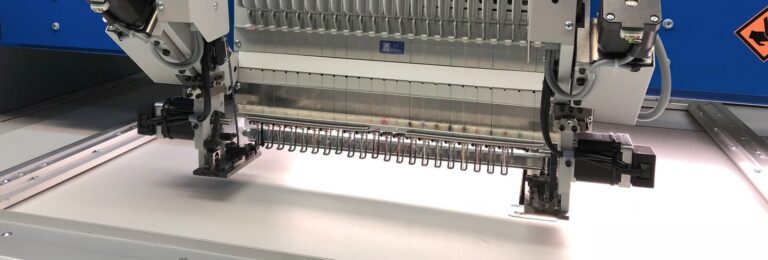
Which devices can be mounted on an F-head?
Regardless of needle count, F-heads can be extended with additional devices; many exist in left and right versions. Typical left-side devices are sequin, bead and cord devices, the hot air cutter and the SEIT laser device; on the right side boring, PCB placement, CamStitch (GMI), cord/loop and 3D loop devices. A center solution allows up to three devices on 18- or 24-needle heads.
Sequin devices
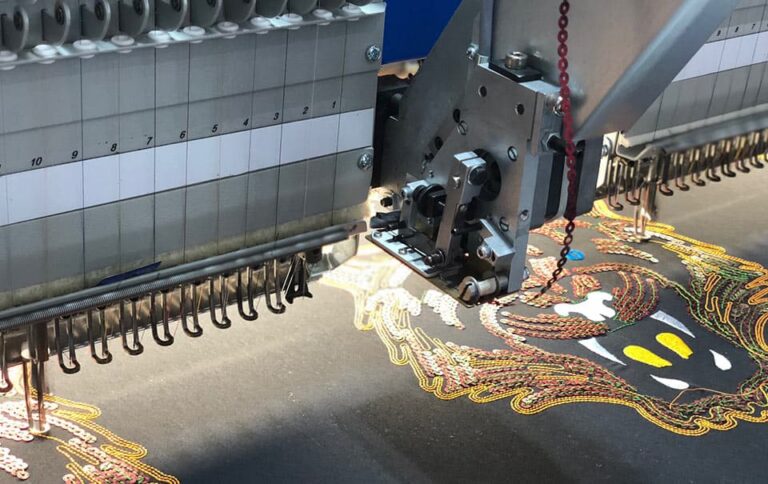
ZSK sequin devices run at 1,000 rpm (older models 700 or 850 rpm), are powered by stepper motors and need no air connection. They adjust to different hole spacings without tools, cut the reels precisely and retract only the sequin foot for thread trimming instead of lifting the whole device (requires MCP35 with CON module and twin sequin device). Three twin devices allow patterns with up to six sequins; with D-drive (double travel), up to 12 different sequins.
| Type | Sizes | Application |
|---|---|---|
| T7 | 2–9 mm | standard sequins |
| T8 | 2–9 mm | supports low-quality sequin reels |
| V6 | 3–9 mm | standard sequins |
| V9 | 3–19 mm | standard sequins, optimized handling |
| Rhinestone | 3–9 mm | rhinestones |
| Function | – | LEDs, thermal sensors, RFID chips, antennas, Bluetooth chips, microcontroller circuits |
Bead devices
Bead devices run at 800 rpm and are also stepper-driven without air. Bead diameters 2, 2.5 or 3.0 mm, bead height 1.5–1.8 mm, minimum hole diameter 0.9 mm. Single and twin devices are available; two twin devices allow patterns with up to four beads, D-drive up to eight different beads. In cooperation with Deshun and Dahao, ZSK plans to integrate Deshun beading devices for a wider variety of bead shapes from 2026 (2-bead setups announced for Q1, 4-bead / 2-sequin setups for Q3).
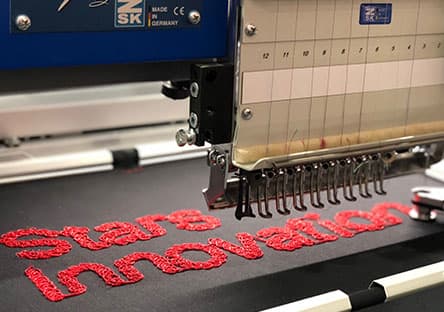
Cord, cord/loop and 3D loop devices
Lays and crimps fancy yarns, cords and necklaces; sequins can be added. A version for technical embroidery is suitable for Tailored Wire Placement.
An economical way to imitate the chenille look on F-head machines. It occupies needles 11/12 or 17/18. Eight feet cover material thicknesses from 0.9 to 3.0 mm; 1.3 and 1.5 mm feet are supplied.
Creates raised 3D loops on border frame, tubular and cap embroidery. Loop height is programmable in the .z00 file; with left and right devices, two colours in one design. Retrofittable on existing machines (models on request).
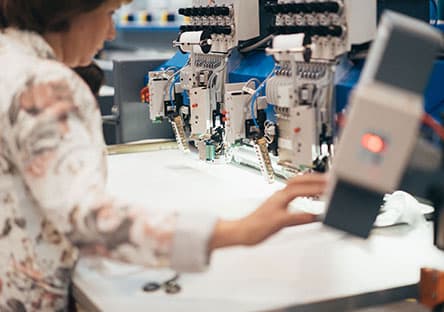
Cutting and boring devices
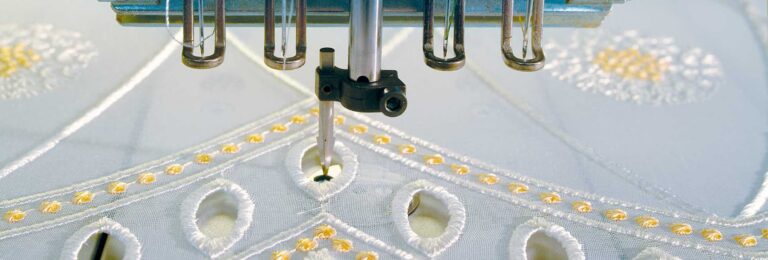
The boring device uses a four-edged stitch tool to bore a hole that needle and thread then embroider around. The laser device (SEIT) cuts appliqués, multilayer and reverse appliqués and bores holes, controlled by commands in the design. The hot air cutter makes 3D cuts and engraves fleece, especially on synthetics.
When does it matter for your production?
Devices matter when your customers pay for effects that plain embroidery cannot deliver: sequins and beads in fashion and stage wear, chenille looks in teamwear, cords for decorative lines, holes for broderie anglaise. Because devices occupy space and needles on the head, plan them when you specify the machine: which side, how many per head, whether you need twin or D-drive versions. For technical products, function sequins and cord devices place electronics and wires automatically.
Related ZSK machines, devices and software
Continue reading
Questions about embroidery devices
Speeds, sizes and limits of sequin, bead and cord devices.
How fast can an embroidery machine stitch sequins?
Current ZSK sequin devices run at an embroidery speed of 1,000 rpm; older models were limited to 700 or 850 rpm. They are driven by stepper motors, so no air connection is needed, and they retract only the sequin foot for thread trimming, which improves performance.
How many different sequins can one design use?
With three ZSK twin sequin devices, patterns can contain up to six different sequins. Using D-drive (double travel), up to 12 different sequins are possible. Sequin sizes range from 2 to 9 mm for T7 and T8 types and from 3 to 19 mm for the V9 device.
Which bead sizes can be embroidered?
ZSK bead devices process beads with diameters of 2, 2.5 or 3.0 mm and a height of 1.5 to 1.8 mm; the bead hole must be at least 0.9 mm. They run at 800 rpm. Two twin devices allow up to four beads per pattern, D-drive up to eight.
How do I get a chenille look without a chenille machine?
The ZSK cord/loop device imitates the chenille look on machines with F-head. It occupies needles 11/12 or 17/18 and uses eight different feet for material thicknesses from 0.9 to 3.0 mm. For genuine chain and moss stitches, a K-head is required.
Can embroidery devices be retrofitted?
Many can. The 3D loop device, for example, can be retrofitted to existing machines, with suitable models confirmed on request; it requires special software and sequin device preparation. Whether a specific device fits your machine depends on head type, needle count and side, so ZSK checks each case.
Need an answer for your application?
Send us your designs, materials and order mix – a ZSK engineer will recommend the right head type, machine concept and options.