

Embroidery heads explained: F-head, R-head, K-head and W-head
F, R, K or W: the head decides which stitches, effects and speeds your machine can deliver. Here is what each ZSK head is built for.
What is an embroidery head?
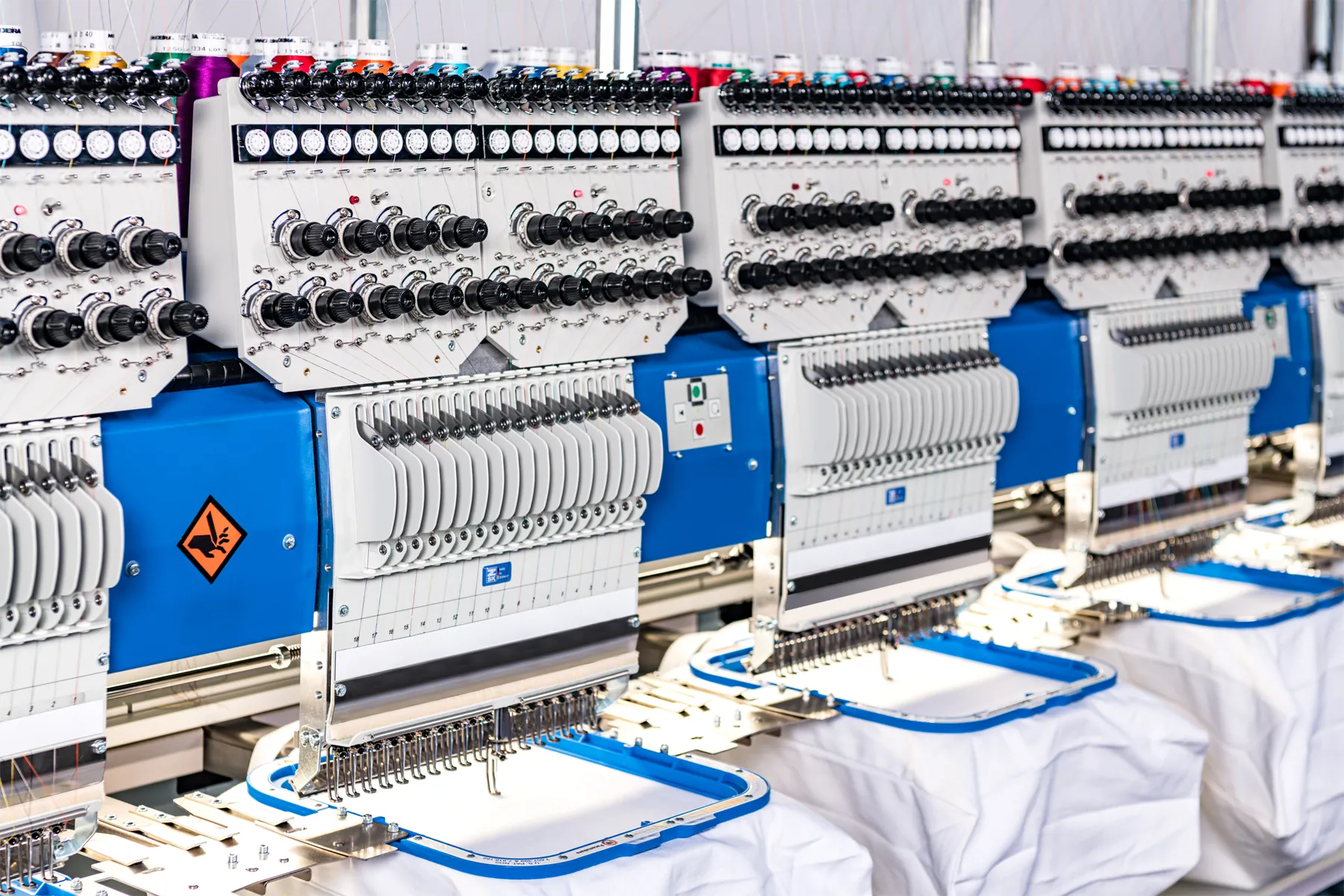
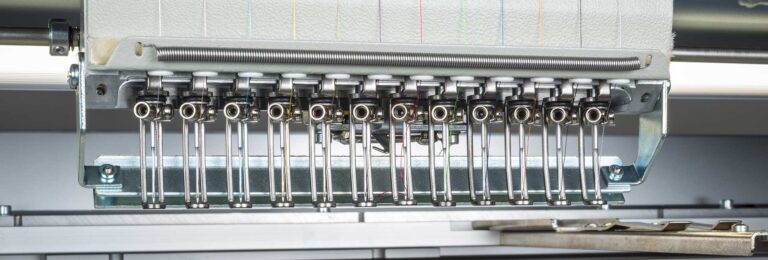
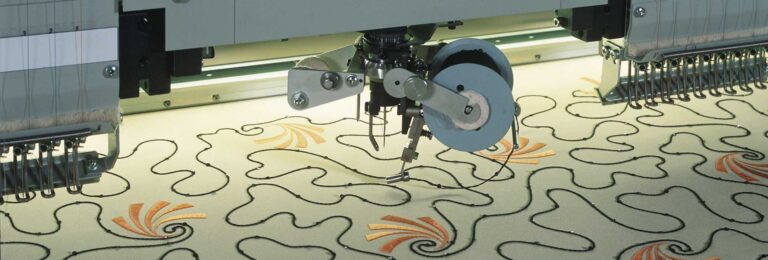
An embroidery head is the unit that forms the stitch: it carries the needle bars, take-up levers, presser foot and thread tensions, and works together with the rotary hook below the table. ZSK builds four head types – the F-head and R-head for standard and decorative embroidery, the K-head for chain and moss (chenille) stitches and the W-head for cording, taping, coiling and technical embroidery.
What does an embroidery head do?
The head decides which stitch types a machine can produce. On a lockstitch head, the needle takes the upper thread through the material, the hook catches the loop and wraps it around the bobbin case, and the take-up lever pulls the stitch tight. Head type, needle count and speed therefore define colour capacity, possible effects and output per shift.
F-head: the standard head for decorative embroidery
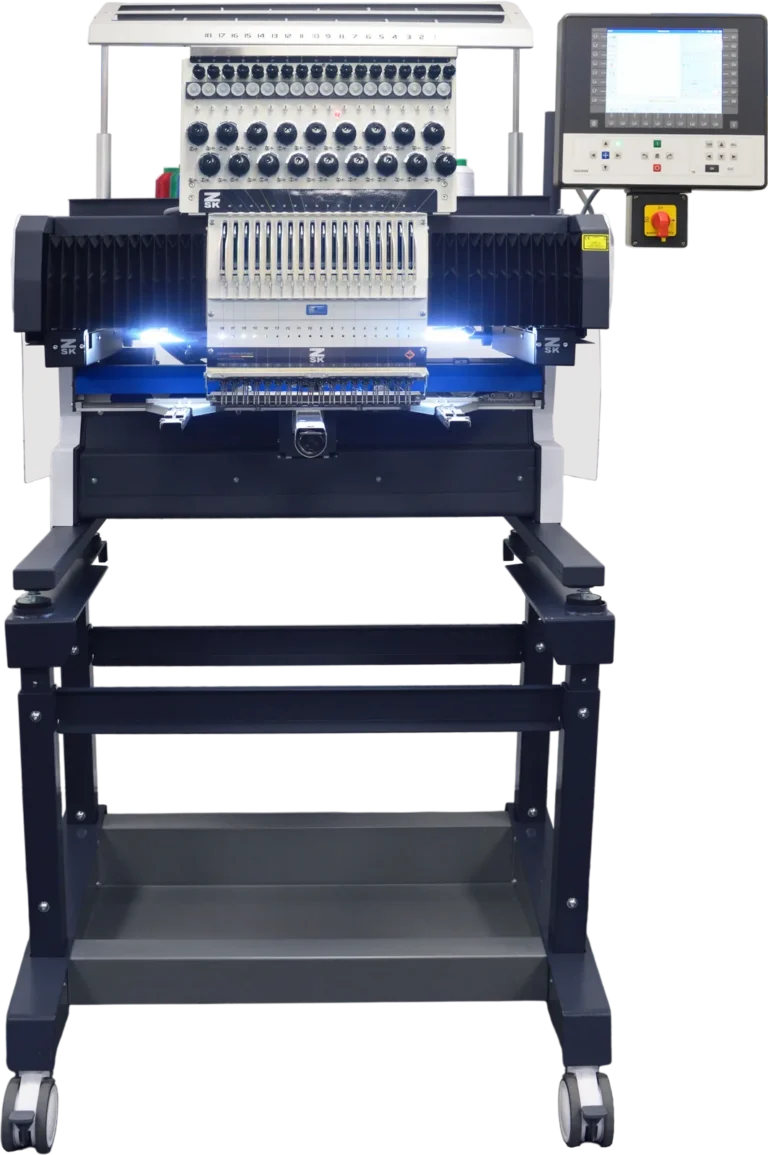
The F-head is ZSK's standard head for decorative embroidery. It is available with 6, 9, 12, 18 and 24 needles (colours), and the ZSK knowledge base specifies speeds of up to 1,200 rpm. The F-head is also the base for additional devices such as sequin, bead and cording devices.
ZSK's F-head optimization – also available as a retrofit kit – brings an optimized needle bar drive and sliding surfaces for lower noise, a longer take-up lever for better thread feeding and a shorter needle block, so stitches can be placed closer to the frame.
R-head: high-speed head of the R-Series
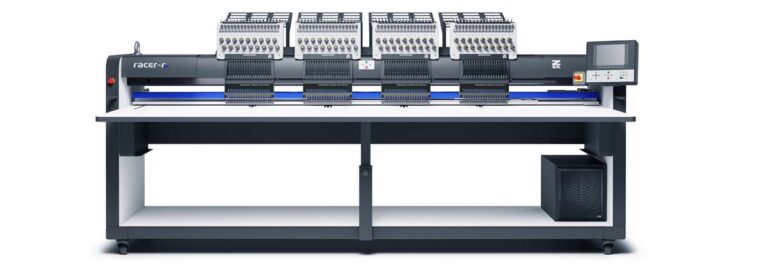
The R-head is intended, like the F-head, for standard and decorative embroidery, but was re-engineered together with pantograph and drives as one high-speed system. Facts from the ZSK catalog and knowledge base:
- 18 needles per head, embroidery speed up to 2,020 rpm.
- First and second order mass balancing reduces torque around the upper beam and vibration.
- Intelligent Presser Foot (IPF): an actively driven presser foot that stays on the material until the needle has left it.
- Individual needle thread clamps and Snapped Back Overload Protection (SBOP), which disconnects the drive if a needle bar is blocked.
- Exchangeable head: it can be replaced without pulling the drive shaft – on multi-head machines this avoids re-adjusting all heads.
The R-head is used in models such as SPRINT R9, RACER R 1W, RACER R 4W and CHALLENGER SGR 0218-700D (1000) SKW.
K-head: chain and moss embroidery (chenille)
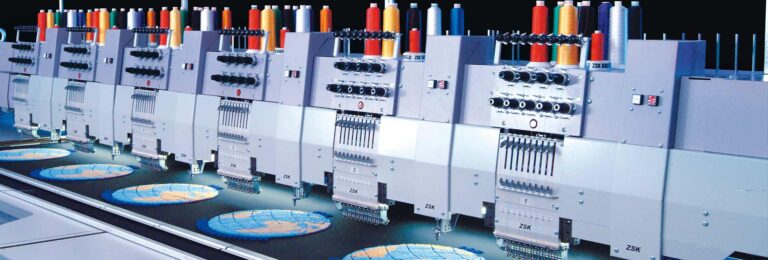
The K-head produces chain and moss stitches, known in the trade as chenille. A crooked needle pulls the thread from beneath the material, at up to 750 rpm. It comes with 6 or 12 thread colours and is fully electronically driven, so stitch formation and loop height can be adjusted on the T8 controller or in the design file. Chain and moss stitches need different thread tensions; ZSK switches them automatically from the embroidery pattern.
W-head: cording, taping, coiling and technical embroidery
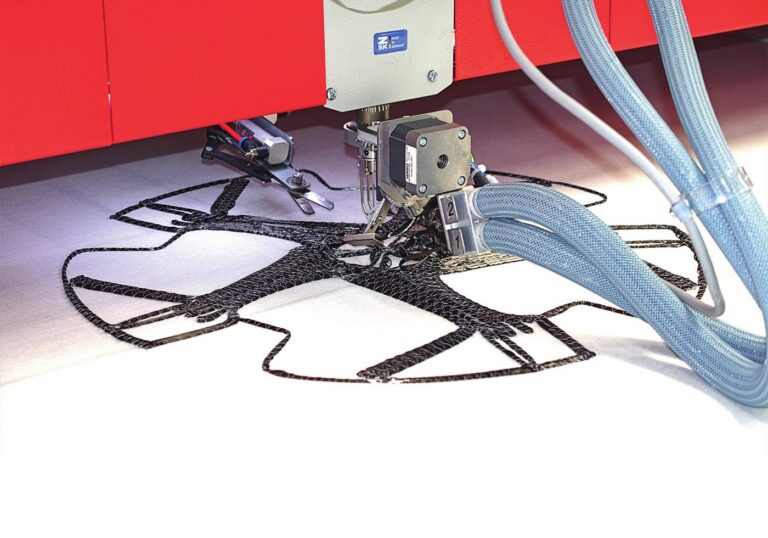
The W-head lays and fixes cords, tapes and fancy yarns with zigzag stitches and also stitches standard embroidery, at up to 850 rpm. It offers coiling with adjustable winding density, 15 zigzag patterns, an unwinding function for rotations beyond 360°. In technical embroidery the W-head is the key head: it places fibres for Tailored Fiber/Fibre Placement (TFP), wires for Tailored Wire Placement (TWP, 0.07–12 mm diameter) and tubes or cables up to 12 mm (Tailored Tube Placement).
Can different heads be combined on one machine?
Yes. F-head + K-head is an H-machine, F-head + W-head a Z-machine, and F-, K- and W-head together a V-machine. Because of its shaft position, the R-head can only be combined with the K-head. The minimum distance between different head types is 275 mm.
When does it matter for your production?
Choose the head by the stitches your orders need, not by the machine frame. Pure logo, name and badge work runs on F- or R-heads; the R-head pays off where speed and quiet operation count over long runs. If you sell varsity jackets or textured fashion, a K-head adds chenille in-house instead of outsourcing it. Cords, tapes, sequin ropes – and every wire, fibre or tube placement job – need a W-head.
Related ZSK machines, devices and software
Continue reading
Questions about embroidery heads
Short answers on head types, needle counts and combinations. For your application, talk to a ZSK engineer.
What is the difference between the F-head and the R-head?
Both are ZSK heads for standard and decorative embroidery. The F-head is available with 6 to 24 needles and is the base for sequin, bead and cording devices. The R-head has 18 needles, reaches up to 2,020 rpm, uses mass balancing against vibration, an actively driven Intelligent Presser Foot and can be exchanged without pulling the drive shaft.
Which embroidery head do I need for chenille?
Chenille (chain and moss stitch) requires the ZSK K-head. A crooked needle pulls the thread from below at up to 750 rpm. The K-head comes with 6 or 12 colours, switches between chain and moss thread tension automatically from the design file and can run on dedicated chenille machines or together with F-heads on H-machines.
What is a W-head used for?
The W-head lays cords, tapes, sequin ropes and fancy yarns with zigzag stitches and also embroiders standard stitches, at up to 850 rpm. It is the central head for technical embroidery: Tailored Fiber Placement (TFP), Tailored Wire Placement with wire diameters from 0.07 to 12 mm, and Tailored Tube Placement for tubes up to 12 mm.
What are H-, Z- and V-machines?
They are ZSK combination machines. An H-machine combines F-head and K-head, a Z-machine F-head and W-head, and a V-machine F-, K- and W-head. They are built as single- and multi-head machines with different head distances and field depths. The minimum distance between different head types is 275 mm; the R-head can only be combined with the K-head.
How many needles can a ZSK embroidery head have?
The F-head is available with 6, 9, 12, 18 and 24 needles, depending on head distance. The R-head has 18 needles, the K-head 6 or 12 colours. More needles mean fewer thread changes between jobs, which is why ZSK offers machines with up to 24 needles per head for multi-colour production.
Need an answer for your application?
Send us your designs, materials and order mix – a ZSK engineer will recommend the right head type, machine concept and options.