


Thread tension and stitch formation in machine embroidery
Most quality problems start with the balance between upper and bobbin thread. ZSK's settings, rules of thumb and checks at a glance.
What is thread tension in embroidery?
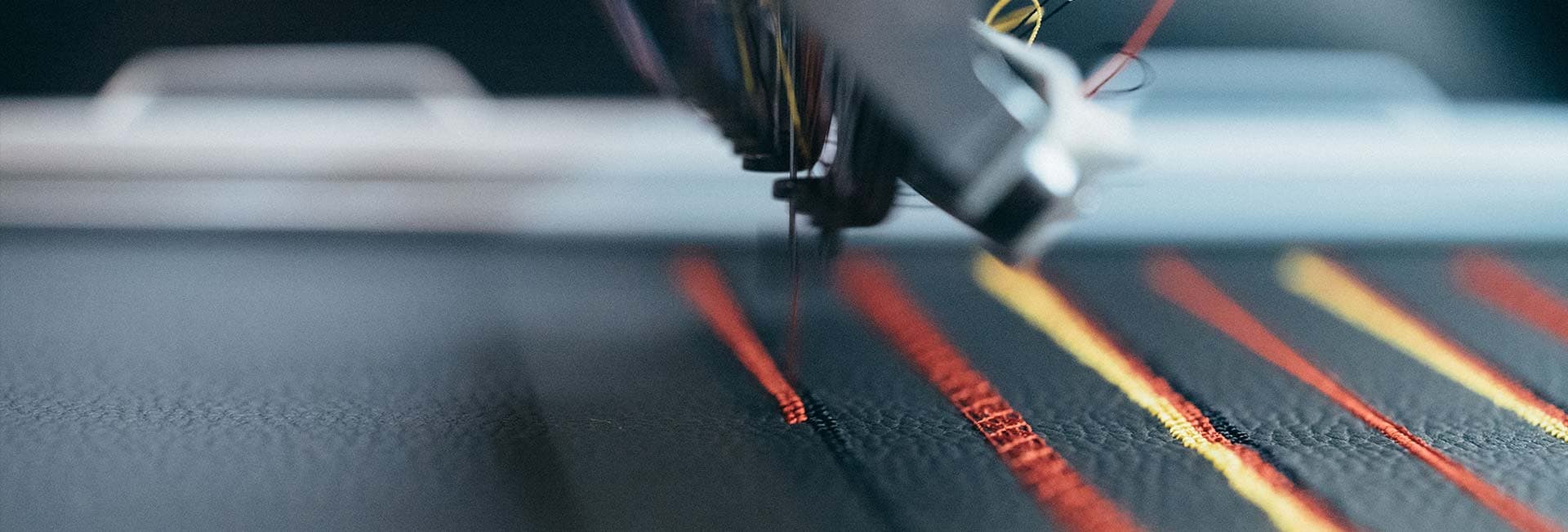
Thread tension is the balance between upper thread and bobbin thread that places the knot of every lockstitch inside the material. It is correct when the material is not pulled together and, according to ZSK, about 60 % of the bobbin thread can be seen in satin stitches. ZSK recommends 25–30 g bobbin tension for 150/180 bobbin thread.
How is an embroidery stitch formed?
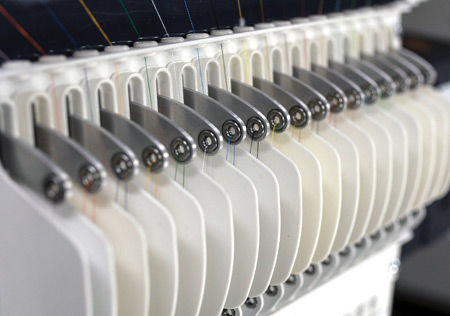
Standard embroidery machines form a lockstitch. The needle carries the upper thread through the material, the rotary hook catches the loop and leads it around the bobbin case, and the take-up lever pulls the loop back up so upper and bobbin thread interlock. Where this interlock sits depends on the two tensions: too much upper tension pulls the bobbin thread to the top, too little leaves loops underneath.
How do you set bobbin thread tension?
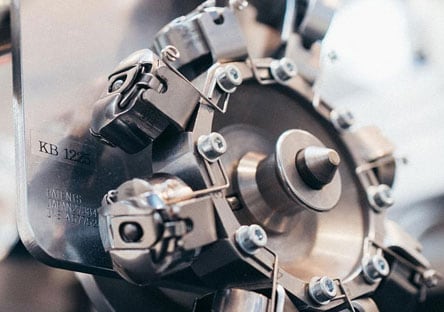
For traditional embroidery ZSK recommends 150/180 bobbin thread at a tension of 25–30 g. Check it with a gauge – ZSK offers a mechanical (Art.No. 570.632) and an electrical tension gauge (Art.No. 570.800). Do not take the thread out of the marked deflection point while measuring. If you use magnetic bobbins, remove the leaf spring from the bobbin case.
How should upper thread tension be distributed?
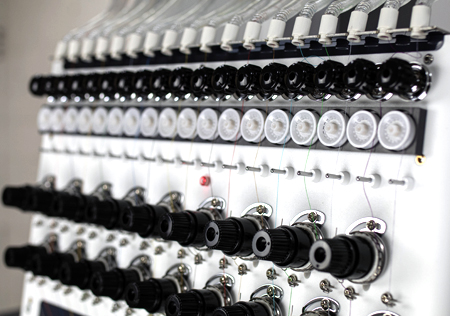
On a ZSK head the upper thread passes three tension points. ZSK's rule of thumb:
The roller is the largest knob but not the main tension; keep it as soft as possible. Exception: on 18-needle heads the thread stays in the slot of the tension bolt. Leather machines can have an additional tension row for extra-thick threads (20s and thicker) for 3D effects; it is not part of the standard machine and is bypassed via guide eyelets for normal thread.
What is the One-Touch-System (OTS)?
With OTS, only the roller tension – recognisable by its blue ring – is adjusted in daily operation:
- STEP 01
Open the roller tension completely.
- STEP 02
Set pre-tensions 1 and 2 so they generate roughly 20–30 % of the upper thread tension (ZSK states approx. 60–70 cN).
- STEP 03
Set the desired tension with the roller tension only.
- STEP 04
Test: pulling off the upper thread must be smooth and even, without jerking.
- STEP 05
From now on, do not touch tensions 1 and 2.
How do you read the stitch?
| What you see | Cause | Correction |
|---|---|---|
| Material flat, approx. 60 % bobbin thread visible in satin columns | Balanced tension | None |
| Little or no bobbin thread visible, upper thread pulled down | Bobbin too tight or upper too loose | Tighten upper or loosen bobbin |
| Bobbin thread shows on the top side | Bobbin too loose or upper too tight | Loosen upper or tighten bobbin |
Special cases: K-head and technical embroidery
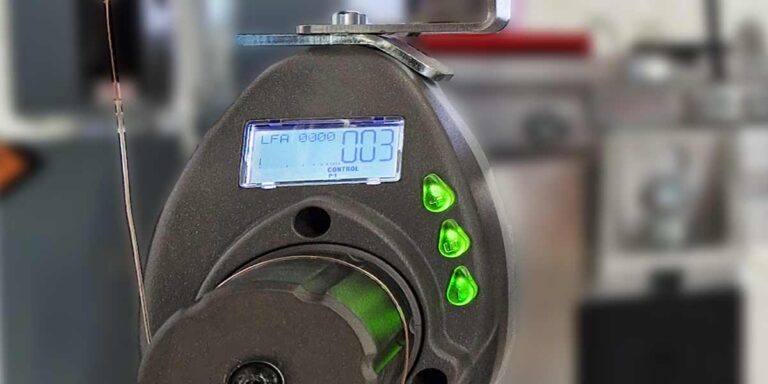
Chain and moss stitches on the K-head need different tensions; ZSK switches them automatically from the pattern (retrofit kits for 6 and 12 colours, 6 bar compressed air). For fibres, conductive yarns and aramid, ZSK's digital thread tension controls upper thread and fibre tension electronically for each stitch and stores the settings for repeat jobs.
When does it matter for your production?
Thread tension is the first thing to check whenever quality drops or thread breaks rise. Check the bobbin tension regularly with a gauge, set the upper tension once using the 10/70/20 rule or OTS, and adjust only the roller afterwards. On metallic, thick or technical threads, revisit the settings per thread type – and store them in the design where the machine allows it.
Related ZSK machines, devices and software
Continue reading
Questions about thread tension
Values and rules of thumb from the ZSK knowledge base.
What is the correct bobbin tension for embroidery?
For traditional embroidery with 150/180 bobbin thread, ZSK recommends a bobbin tension of 25–30 g. Measure it with a mechanical or electrical tension gauge and leave the thread in the marked deflection point while measuring. With magnetic bobbins, remove the leaf spring from the bobbin case first.
How do I know the thread tension is right?
According to ZSK, thread tension is correct when the material is not pulled together and about 60 % of the bobbin thread is visible in satin stitches. If almost no bobbin thread shows, the bobbin is too tight or the upper thread too loose. If the bobbin thread appears on top, the reverse applies.
Which upper thread tension is the main tension?
On ZSK heads the middle thread tension is the main tension and should carry about 70 % of the upper thread tension. The thread stand tension takes about 10 %, the roller tensioner about 20 %. Although the roller is the largest knob, it is not the main tension and should be kept as soft as possible.
What is the One-Touch-System for thread tension?
With the ZSK One-Touch-System (OTS), pre-tensions 1 and 2 are set once to about 20–30 % of the upper thread tension, approximately 60–70 cN. After that, the operator adjusts tension only with the roller tensioner marked with a blue ring. This makes daily adjustment faster and more consistent.
Why do chain and moss stitches need different thread tensions?
Chain and moss stitches are formed differently on the K-head and need different upper thread tensions. ZSK switches the tension automatically from the embroidery pattern, so mixed chenille designs run without manual intervention. Retrofit kits for 6- and 12-colour K-heads are available and need 6 bar compressed air.
Need an answer for your application?
Send us your designs, materials and order mix – a ZSK engineer will recommend the right head type, machine concept and options.