

Head selection and combination machines: more flexibility from multi-head embroidery
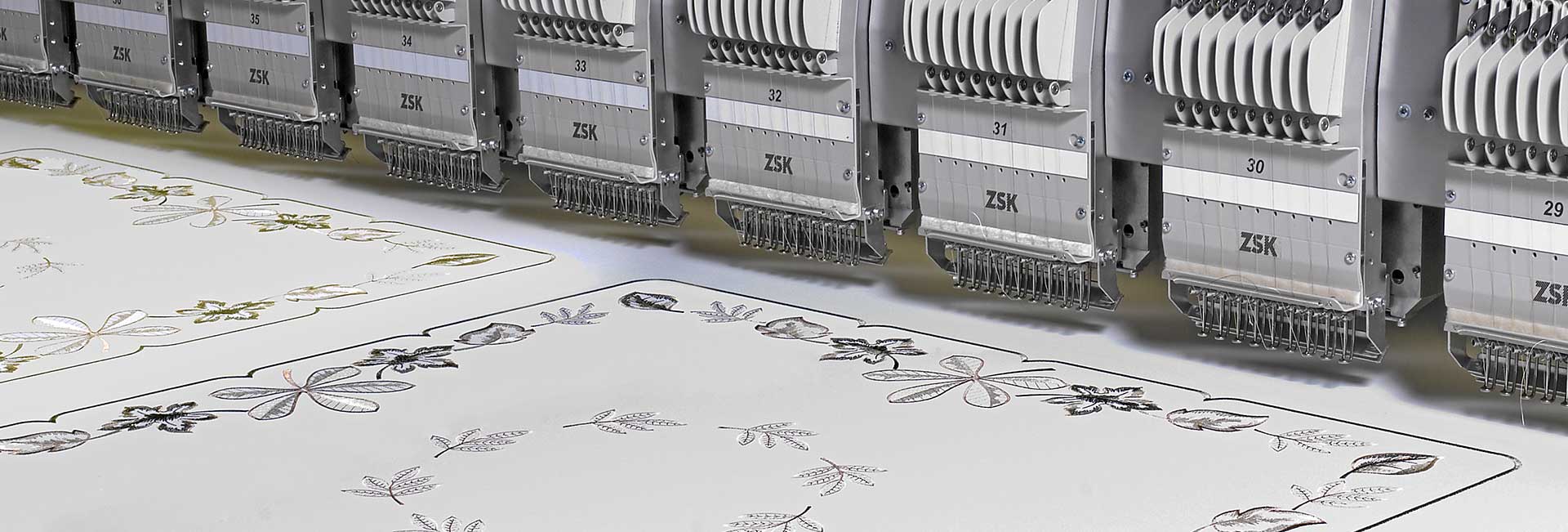
Switch heads on and off from the design, multiply the field per head or combine head types on one frame – without stopping the machine.
What is head selection?
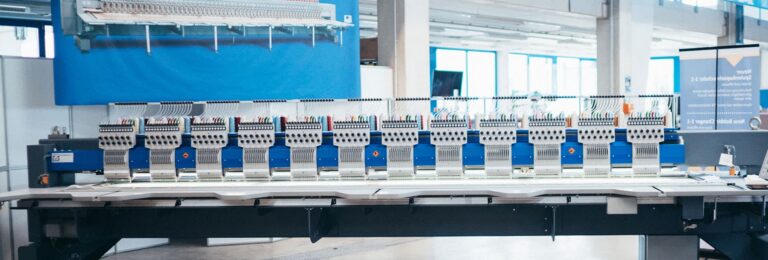
Head selection is the function that switches individual embroidery heads of a multi-head machine on or off during embroidery – stored in the design and executed without a machine stop. On flatbed machines, the same principle lets two, three or four heads' worth of field be used by one head; combination machines go one step further and combine different head types on one frame.
How does automatic head selection work?
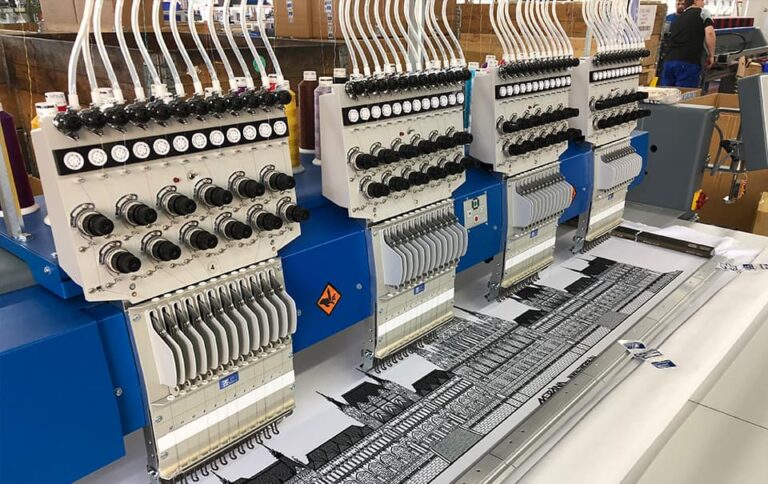
Individual heads can be switched on or off during embroidery. The switch-off is stored in the embroidery design and takes place automatically – without a machine stop and without the operator intervening. Shortcuts by barcode can load a design together with its starting point, stops and head selection from the network. ZSK RACER machines have automatic head selection as standard.
Example: name patches with Quicktext
Conventionally, team names on a multi-head machine mean: embroider the logo on all heads, stop, switch off every head except head 1, embroider the first name, stop again, switch to head 2 – and so on. With head selection you load a list of names in BasePac Quicktext together with the logo. The logo is embroidered on all heads at the same time, then the heads work through the names individually, without manual stops.
What do D, T and Q mean in a ZSK model code?
On flatbed machines, head selection also multiplies the usable field width per head. Take SGFA 1206-48/4: 12 heads, 6 needles, head spacing 48/4 inch = 12 inch = 324.84 mm.
| Suffix | Operating modes | Field per head |
|---|---|---|
| none (single) | 12 heads | 324.84 × 700 mm |
| D (double) | 6 or 12 heads | 649.68 × 700 mm |
| T (triple) | 4, 6 or 12 heads | 974.52 × 700 mm |
| Q (quadruple) | 3, 4, 6 or 12 heads | 1,299.36 × 700 mm |
With Q, D operation is always possible; T operation with Q only if the number of heads is divisible by both three and four. On the CHALLENGER and Flat Series, head selection enables border frame motifs up to 9,000 mm wide without changing frames; on technical embroidery machines, automatic head switching allows laying fields up to 9,000 × 3,000 mm. Note: “CHALLENGER YGF …” is the CHALLENGER machine type, while a prefix “C” (e.g. CYGF) means a standard flatbed with CHALLENGER drive technology.
What are combination machines?
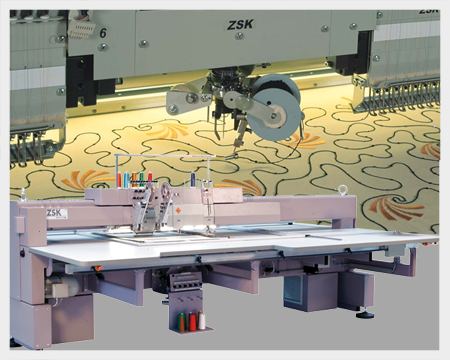
Combination (mixed-type) machines put different head types on one frame, so one product can receive several techniques in a single workflow:
They are built as single- and multi-head machines with various head distances and field depths. The F-head carries 6, 9, 12, 18 or 24 needles (depending on head distance), the K-head 6 or 12. The minimum distance between different head types is 275 mm. The R-head can only be combined with the K-head because of its shaft position.
F-head + K-head (embroidery + chenille)
F-head + W-head (embroidery + cording/taping/coiling)
F-head + K-head + W-head
Two compact examples: RACER H 0118 and RACER Z 0118
Both combine an 18-needle F-head with fast colour change and a second head on a 495 × 500 mm field. The RACER H 0118 adds a 6-needle K-head and a split table so the F-head can run tubular and cap embroidery. The RACER Z 0118 adds a W-head that can also stitch in tubular hoops and a removable table. In border frame mode, both heads work together.
When does it matter for your production?
Head selection matters as soon as your multi-head work is not 100 % identical repeats: names, sizes, mixed quantities, or one oversized motif. If you regularly stop the machine to switch heads by hand, you lose time on every job. Combination machines matter when your designs combine chenille or cording with standard embroidery – one pass instead of two machines and two hoopings.
Related ZSK machines, devices and software
Continue reading
Questions about head selection
How heads are switched and combined – in brief.
What is head selection on an embroidery machine?
Head selection switches individual heads of a multi-head machine on or off during embroidery. On ZSK machines the switching can be stored in the design and runs automatically, without a machine stop or manual intervention. It is used for name patches, mixed quantities and for using a wider field per head.
What does the D in a ZSK model code such as SGFA 1206-48/4 D mean?
D stands for double field width through head selection. An SGFA 1206-48/4 D (700) can run with 12 heads and a 324.84 × 700 mm field per head, or with 6 heads and a 649.68 × 700 mm field. T (triple) and Q (quadruple) extend this to three and four times the width.
What is an H-machine, Z-machine or V-machine?
These are ZSK combination machines. H combines F-head and K-head for embroidery plus chenille, Z combines F-head and W-head for embroidery plus cording, taping and coiling, and V combines all three. The minimum distance between different head types is 275 mm. Typical uses are chenille lettering combined with standard embroidery, or cords and tapes added to a logo in one pass.
Can I embroider different names on each head of a multi-head machine?
Yes. Load a list of names with the logo in BasePac Quicktext. The machine embroiders the logo on all heads simultaneously, then uses head selection to work through the names head by head – without stopping to switch heads manually. This removes the manual stops that conventional name production on a multi-head machine requires after every name.
How wide can a border frame design be on a ZSK flatbed machine?
Using head selection, ZSK CHALLENGER and Flat Series machines can embroider border frame motifs up to 9,000 mm wide without changing frames. Technical embroidery machines reach laying fields up to 9,000 × 3,000 mm through automatic head switching. Even larger, almost unlimited laying fields are possible with automated pull-through systems.
Need an answer for your application?
Send us your designs, materials and order mix – a ZSK engineer will recommend the right head type, machine concept and options.