


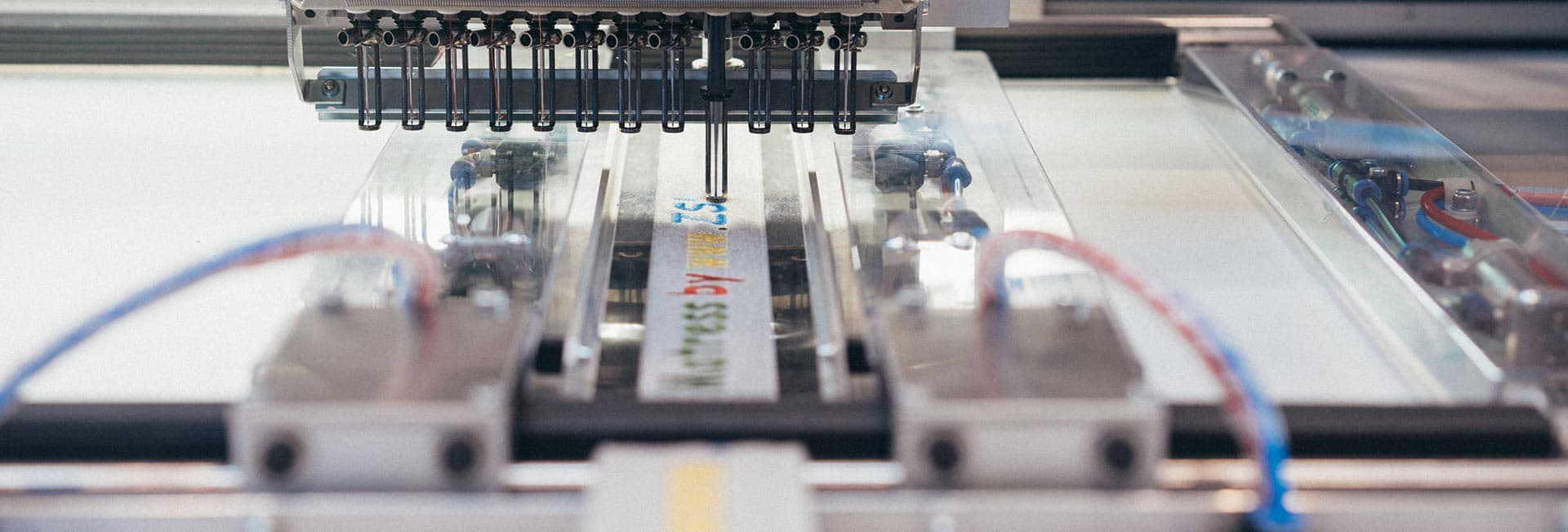
Automated patch production: Roll2Roll, Roll2Cut, Roll2Basket and inline tapes
Embroider patches, labels and tapes from the roll instead of hooping, cutting and aligning every piece by hand.
What is automated patch production?
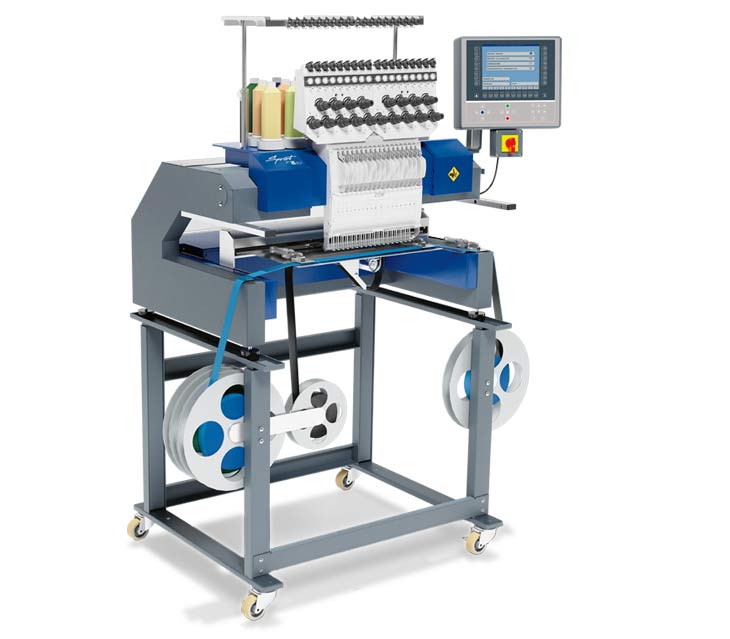
Automated patch production means embroidering patches, labels and tapes continuously from the roll, instead of hooping, cutting and aligning each piece by hand. ZSK combines embroidery machines with pull-through systems – Roll2Basket, Roll2Roll and Roll2Cut – and with a patented two-step process for hook-and-loop patches.
Why automate patch production?
Conventional hook-and-loop patches take six steps: embroider the emblem on backing, cut each patch by hand (often outsourced), embroider positioning marks on the hook or adhesive tape, align every emblem by hand, join emblem and tape with a separate file, then cut again. Each manual step costs time and adds placement errors. Automated systems keep the material on the roll and the position under machine control.
How does automated hook-and-loop patch production work?
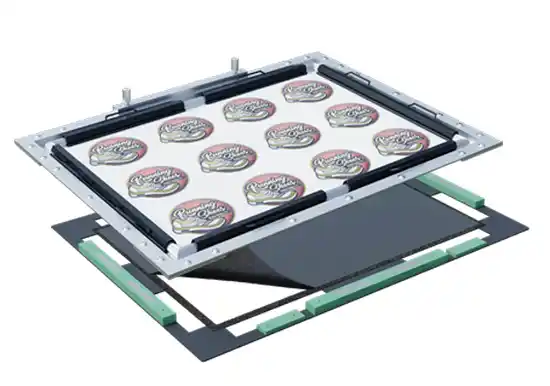
Tape widths of 25–50 mm are possible, 15–25 mm with minor changes. The SPRINT patch solution is patented, works with embroidery areas up to 100 × 50 mm and is ordered as an integrated system (not retrofittable). For single pieces, the ZSK hook-and-loop frame gives each patch a precisely positioned seam while the hook material stays intact.
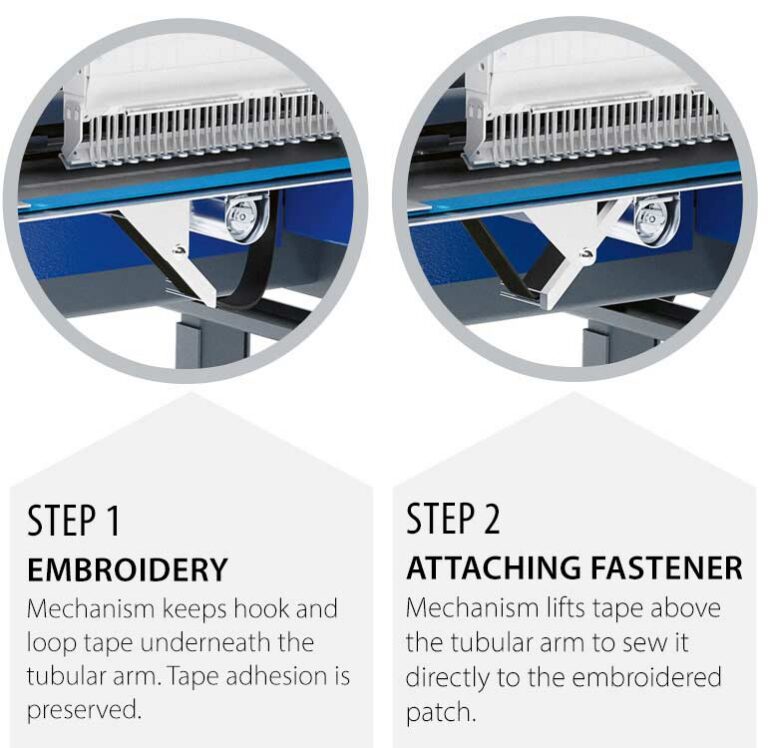
A mechanism keeps the hook tape underneath the tubular arm, so the adhesion of the hooks is preserved.
The mechanism lifts the hook tape above the tubular arm and it is sewn to the embroidered tape.
The system can be paired with laser cutting solutions, for example from Willy Italiana or SEIT.
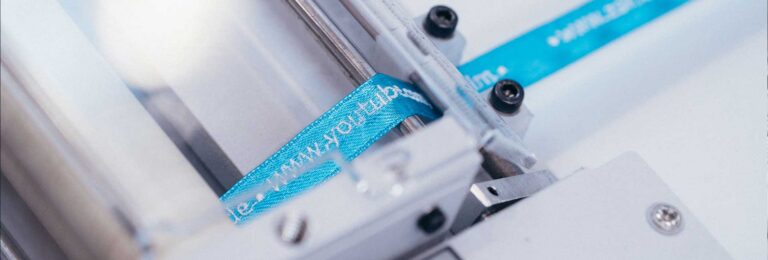
Roll2Basket: labels and ribbons into a container
Fabric is unwound from a roll, embroidered and collected in a basket or on an automatic winding station. Retrofittable for SPRINT and RACER machines.
Roll2Basket data: max. roll diameter 400 mm, material thickness 0.2–5.0 mm, embroidery field 150 × 200 mm, 900 rpm; all systems need compressed air. Typical products: name tags, care and brand labels, safety ribbons, piping and textile borders.
| System | Material width | Min. head distance | Storage |
|---|---|---|---|
| Roll2Basket + basket | 10–150 mm | 400 mm | container |
| Roll2Basket + winding station | 10–150 mm | 400 mm | winding station |
| Roll2Roll guiding | 190 / 160 mm | 495 mm | on a roll |
| Roll2Roll clamping | 190 / 140 mm | 495 mm | on a roll |
Roll2Roll and Roll2Cut: continuous production
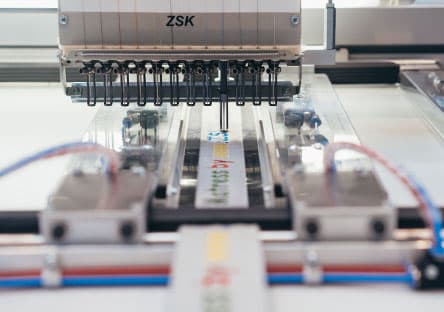
Roll2Roll embroiders belts, tapes and textile rolls semi- or fully automatically: several materials such as cloth and felt are fed, embroidered and rolled up again at the front of the machine. Pull-through runs back-to-front and side-to-side; pneumatic clamping and stamps close to the needle keep the position during re-tensioning, so the embroidery field becomes a multiple of the frame depth. On RACER machines Roll2Roll is available from 495 mm head spacing (1-, 2- and 6-head) and must be specified at order. The RACER R1 Roll2Roll combines this with the R-head: 18 colours, fields up to 500 × 500 mm and up to 2,020 rpm. Roll2Cut feeds fabric from a roll, embroiders it, then cuts it into pieces stacked in front of the machine.
Inline quality control and laser cutting
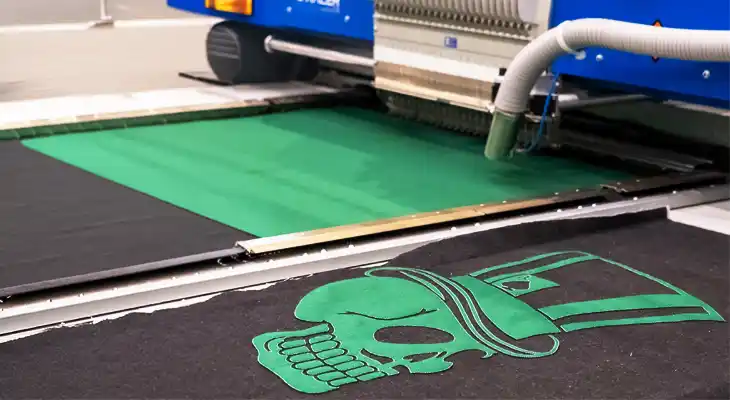
For tapes and patches, ZSK Roll2Roll can be linked inline with optional quality control (Willy Italiana Checklabel marks defects without stopping) and laser cutting (Willy Italiana Laserlabel). A camera detects the patch outline automatically – no CAD data needed unless the cut contour differs from the motif; detection needs a closed contour. Working area 260 × 200 mm; suitable for textile ribbons and hook-and-loop tape, not for natural fibres.
When does it matter for your production?
Automation matters when patches, labels or tapes are a steady product line rather than an occasional order. If you cut, align and sew patches by hand today, every step removed saves labour and reduces positioning errors. Because some systems (Roll2Roll on RACER, the SPRINT patch solution) are not retrofittable, decide before you order the machine – Roll2Basket can be added later.
Related ZSK machines, devices and software
Continue reading
Questions about patch automation
Systems, widths and requirements in brief.
How can embroidered patches be produced automatically?
ZSK machines embroider patches directly on tape from the roll. For hook-and-loop patches, a mechanism first keeps the hook tape under the tubular arm during decorative embroidery, then lifts it so it is sewn to the embroidered tape. Patches can then be cut inline by laser. This replaces six largely manual steps with three automated ones.
What is the difference between Roll2Basket and Roll2Roll?
Roll2Basket unwinds 10–150 mm wide ribbons, embroiders them and collects them in a basket or on a winding station; it is retrofittable on SPRINT and RACER. Roll2Roll embroiders wider materials up to 190 mm, can feed several materials and rolls the result up again; on RACER it needs 495 mm head spacing and must be specified at order.
Which tape widths can be used for hook-and-loop patches?
The ZSK solution for automated hook-and-loop patches works with tape widths of 25–50 mm; with minor changes, 15–25 mm is possible. The SPRINT patch solution handles embroidery areas up to 100 × 50 mm and is supplied as an integrated system.
Can embroidered patches be laser-cut inline?
Yes. ZSK Roll2Roll can be connected to the Willy Italiana Laserlabel for laser cutting and to the Checklabel for quality control. A camera detects the patch outline automatically; a closed contour is required. The working area is 260 × 200 mm, suitable for textile ribbons and hook-and-loop tape, but not for natural fibres.
Do pull-through systems need compressed air?
Yes. Roll2Basket and Roll2Roll systems in the ZSK range require compressed air for pneumatic transport, clamping and tensioning. ZSK pneumatic installations generally require compressed air at 6 bar. Plan the air supply when you specify the machine, because clamping and material transport depend on it.
Need an answer for your application?
Send us your designs, materials and order mix – a ZSK engineer will recommend the right head type, machine concept and options.