


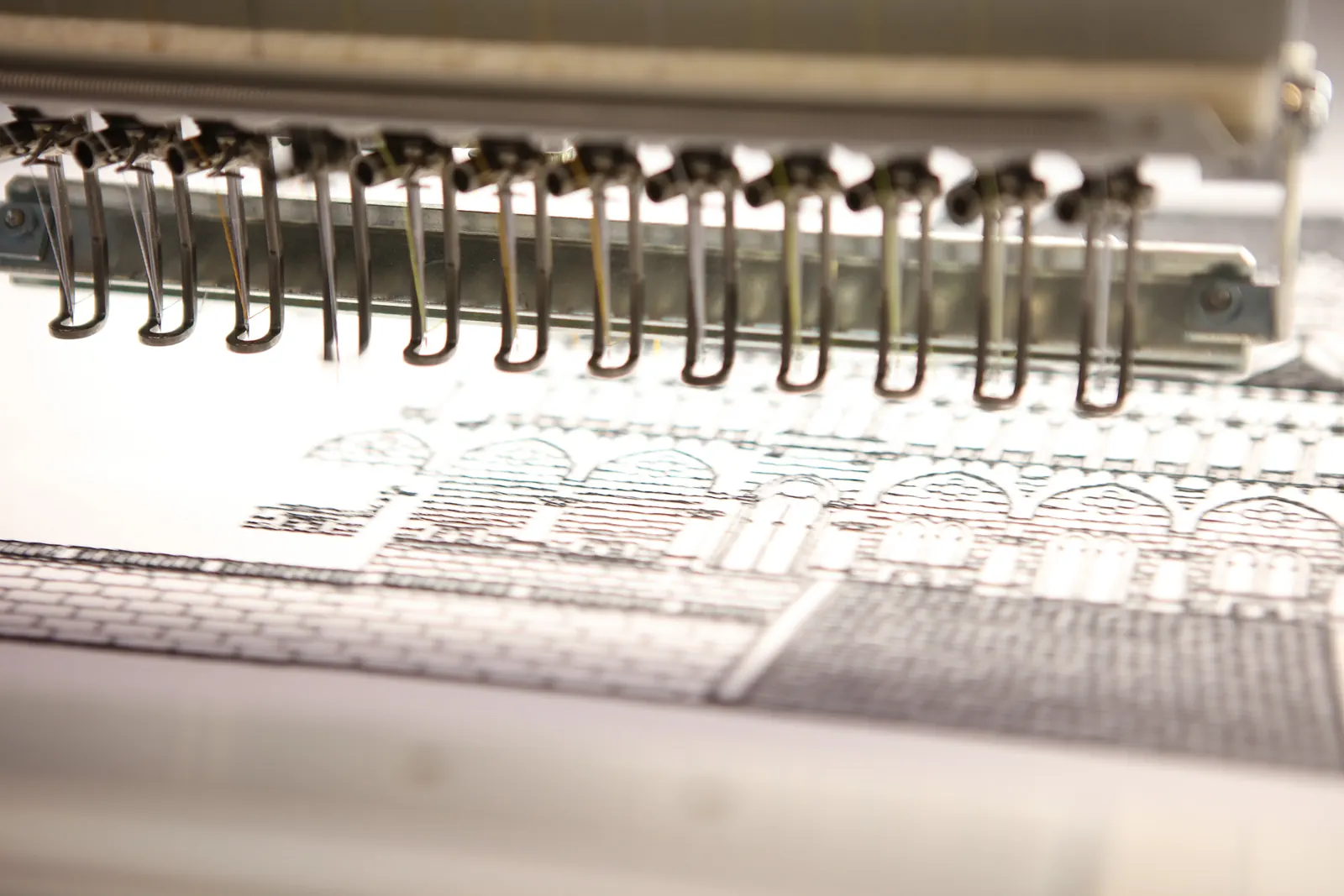
Embroidery machine needles: DBxK5 system, point styles and sizes
The needle is the cheapest part of the machine and one of the most frequent causes of thread breaks, holes and skipped stitches. Choose it by system, size and point – and change it before it wears.
Which needle does an embroidery machine use?
Industrial multi-needle embroidery machines typically run needles of the DBxK5 system. A needle is defined by three things: the system (shank and length, e.g. DBxK5), the size (e.g. 75/11 – metric Nm and US number) and the point style (e.g. RG, FFG, SD), matched to fabric and thread. ZSK Campus names a DBxK5 75/11 with RG point as the universal starting point.
What does a size like 75/11 mean?
Embroidery needles carry two numbers: the metric size (Nm) and the US size. In the metric system the number stands for the blade diameter in hundredths of a millimetre – a 75 is thicker than a 65 and thinner than a 90. Both numbers describe the same needle: 75/11, 80/12, 90/14.
Practical rule from ZSK Campus: 75 for everyday work, 60–65 for small lettering, 75–90 for 3D puff. The ZSK knowledge base recommends size 60 or 65 with RG or SES point for small logos and symbols. Thicker threads need thicker needles – the shop carries DBxK5 from 60/8 up to 140/22.
Which point style for which material?
The point decides whether the needle pierces or pushes the fibres aside. Designations differ by manufacturer – the shop lists the equivalents for each needle.
| Point | Also called | Recommended for (shop / Campus) | Example |
|---|---|---|---|
| RG | STU, STUB, S BALL, SET RT, EH | Knitwear, woven fabrics, leather – the universal point | DBxK5 75/11 RG |
| R | SET, RD | Fine wovens, leather, artificial leather; emblems, logos, monograms, fine lettering | DBxK5 R 60/8 |
| FFG | SES, L BALL, J BALL, SIN | Knitwear and woven fabrics; ball point for knits such as polo shirts | DBxK5 FFG 75/11 |
| FG | SUK, B BALL, M BALL | Ball point; Schmetz SUK listed for knitted fabrics | DBxK5 FG 75/11 |
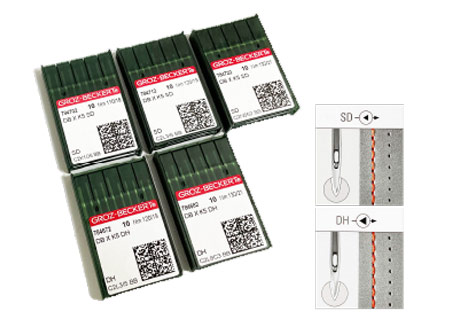
| SD | R-TRI, TRI FACET, TRI TIP | Cutting point for thin leather: fine leather goods, shoes | DBxK5 SD 110/18 |
| DH | – | Heavy sizes 90–130 for special work; ask us for your material | DBxK5 DH 110/18 |
Point descriptions and recommendations are taken from the product pages in the ZSK online shop and from ZSK Campus.
Which special needles solve which problem?
Beyond point and size, shank length, coatings and groove design matter.
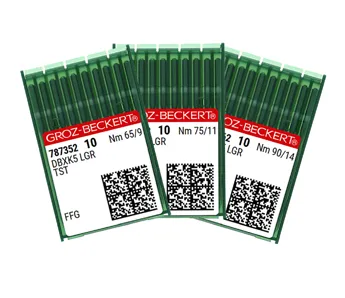
Groz-Beckert DBxK5 LGR: the thread groove extends into the shank, so the thread is not pinched when the needle dives deep into puffy foam – fewer thread breaks and skipped stitches. FFG point, sizes 65/9, 75/11, 90/14.
LGR 75/11 →LGR 90/14 →Groz-Beckert DBxK5 SAN 1 with GEBEDUR coating and RG point is listed for embroidery on sturdy products such as baseball caps. Sizes 60/8 to 80/12.
SAN 1 75/11 →SAN 1 80/12 →Organ Needles DBxK5 Z1 NY, size 80/12, with titanium-nitride coating, recommended by ZSK for very dense or tough materials and heavy-duty fabrics.
DBxK5 Z1 NY →DBxK5 KK has a short shank, DBxK5 SS a very short shank; both with RG or FG point for all kinds of embroidery. Check which shank your machine needs before ordering.
DBxK5 KK 75 →DBxK5 SS →Groz-Beckert 1738A in 120/19 and 130/21 with FFG point is listed for jeans over 14 oz, upholstery, belts and awnings; with R point for medium to heavy knitwear, wovens and technical textiles.
1738A 120/19 →The ZSK K-head forms chain and moss stitches with a crochet needle of system CEX3 (Groz-Beckert and Schmetz, 70/10 to 120/19). Match the fabric presser insert to the size: 0.8 mm for 70/80, 1.0 mm for 90/100, 1.2 mm for 110/120.
CEX3 90/14 →Which needle for which job?
| Job | Start with | Shop |
|---|---|---|
| Everyday logos on wovens and knits | DBxK5 75/11 RG | DBxK5 75 |
| Polo shirts and other knits | DBxK5 FFG (ball point) | FFG 75 |
| Small lettering and fine details | DBxK5 60–65, RG or R point | DBxK5 65 · R 60 |
| Baseball caps | DBxK5 SAN 1 GEBEDUR | SAN 1 75 |
| 3D puff on foam | DBxK5 LGR 75/11–90/14 | LGR 75 |
| Thin leather, shoes | SD point (DBxK5 or DBX1) | DBX1 SD 80 |
| Jeans > 14 oz, belts, awnings | 1738A FFG 120/19–130/21 | 1738A 120 |
| Very dense or tough materials | Organ DBxK5 Z1 NY 80/12 | Z1 NY |
| Chenille (ZSK K-head) | CEX3 | CEX3 |
Always confirm with a test piece on the original material.
When should you change the needle?
ZSK Campus lists a worn or wrongly inserted needle among the usual causes of upper thread breaks – together with incorrect threading, too much upper tension, poor thread and very dense designs. The first steps: rethread, change the needle, then measure the tension. For 3D puff, always start with a new needle; a blunt needle causes frayed foam edges.
The ZSK embroidery needle alignment aid helps insert needles correctly. Holes in the fabric despite backing can also point to an unsuitable or damaged needle, a wrong size or point.
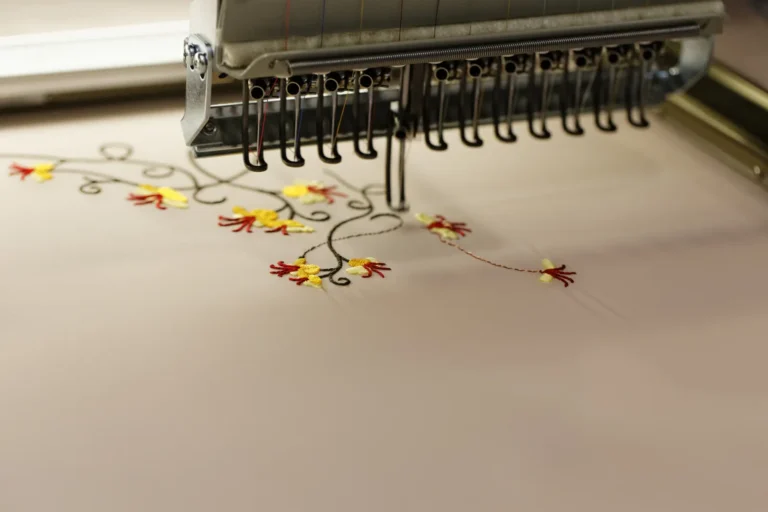
Embroidery needles in the ZSK online shop
Needles from Groz-Beckert, Schmetz and Organ Needles for single- and multi-head machines – ZSK and many other brands. No minimum order.
Questions about embroidery needles
Short answers on systems, sizes and points.
Which needle system do embroidery machines use?
Industrial multi-needle embroidery machines typically use the DBxK5 system. Within DBxK5 there are variants such as KK (short shank), SS (very short shank), SAN 1 and LGR. Other systems in the ZSK shop include DBX1 and 1738A for special materials and CEX3 for chenille on the ZSK K-head. Check your machine manual for the correct system.
Which needle size should I use?
Size 75/11 is the everyday starting point. Use 60–65 for small lettering and fine details – the ZSK knowledge base recommends 60 or 65 with RG or SES point for small logos – and 75 to 90 for 3D puff on foam. Thicker threads and heavy materials need larger sizes; the shop carries DBxK5 up to 140/22.
What is the difference between RG and FFG points?
RG is the universal point for knitwear, wovens and leather; ZSK Campus names DBxK5 75 RG as the starting point. FFG is a ball point that pushes knit loops aside instead of piercing them, which is why Campus recommends it for knits such as polo shirts. Both are available in the ZSK shop in many sizes.
Which needle is best for caps?
For sturdy products such as baseball caps, Groz-Beckert offers the DBxK5 SAN 1 with GEBEDUR coating and RG point, in the ZSK shop from 60/8 to 80/12. For 3D puff on caps, use the DBxK5 LGR, whose long thread groove protects the thread inside thick foam.
Which needle should I use for leather?
For thin leather, the shop lists needles with an SD point (a cutting point, also called R-TRI or TRI FACET), for example DBX1 SD 80/12 or 100/16 for fine leather goods, shoes and embroidery on leather. The RG and R points are also listed for leather and artificial leather. Test on an offcut first.
Which needle brands does the ZSK shop sell?
The ZSK online shop sells embroidery needles from Groz-Beckert, Schmetz and Organ Needles for single- and multi-head embroidery machines – ZSK and many other industrial models. There is no minimum order, so you can also buy a single pack to test a new needle such as the DBxK5 LGR.
Why do I get thread breaks after changing fabrics?
A needle that suited the last job may be wrong for the new fabric – wrong point, wrong size or simply worn. Rethread, insert a new needle of the right type, then measure the upper and bobbin tension. ZSK recommends a bobbin tension of 25–30 g for conventional embroidery. If breaks persist, check design density.
Continue reading
Unsure which needle fits your material?
Tell us fabric, thread and machine – a ZSK expert recommends system, size and point. Then order online: the ZSK shop supplies every machine brand, with no minimum order.