
Software for automated embroidery data generation
Nodety – from Design directly to the Embroidery Machine
Nodety is a parametric design-to-production platform that generates embroidery data directly from text, images, vector graphics and 3D content. Changes to content and parameters are applied in real time – without having to rebuild designs from scratch.
Especially relevant for ZSK users: Nodety can write technical and production-related data directly into the ZSK transport code .z00. This creates a direct path from design to machine.
Why traditional embroidery data workflows reach their limits
In professional embroidery, the creation of embroidery data is still largely based on document-based applications. That works well as long as designs remain unchanged. As soon as text, sizes, perspectives or recurring design elements need to be adjusted, the workload increases significantly.
Variants often have to be rebuilt manually, effects have to be recreated, or embroidery files have to be prepared several times. Especially for personalised products, recurring layouts or standardised design systems, this approach quickly becomes time-consuming and prone to errors.
What makes Nodety different
Nodety replaces work with static files with a parametric system.
Designs are not just fixed end results. They consist of linked steps and rules that remain editable. This means existing designs can be adjusted at any time without having to rebuild individual steps.
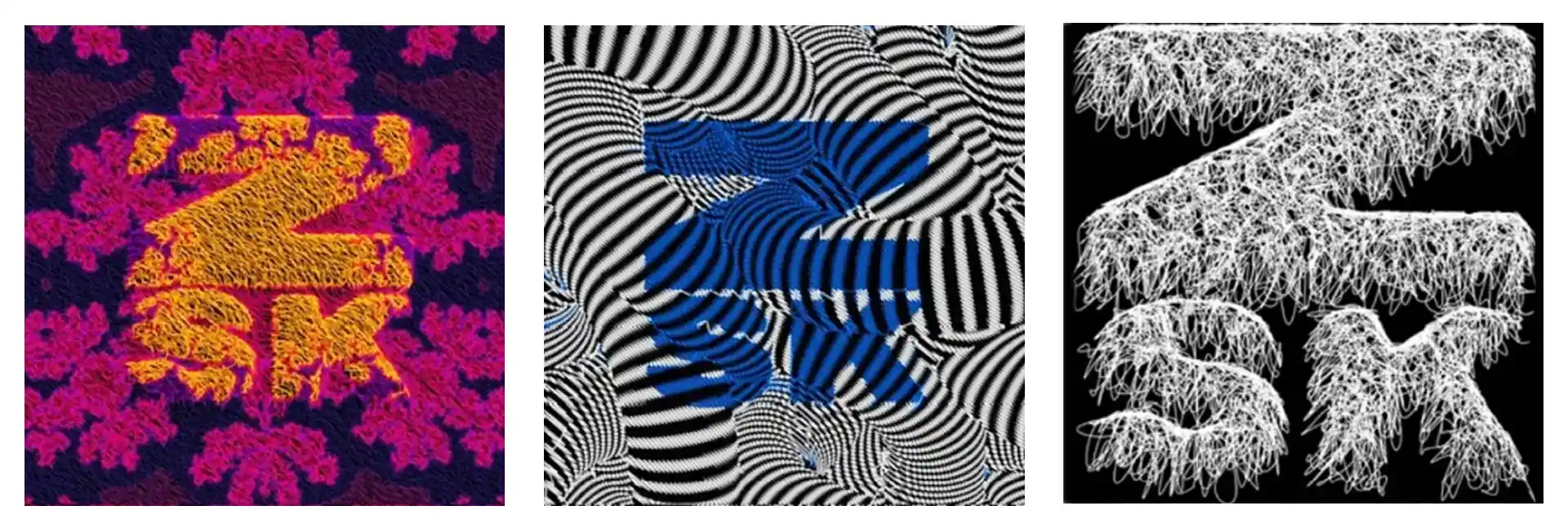
Parametric working instead of static files
Elements such as text, shapes, effects, perspectives or structures remain editable. When a parameter is changed, all dependent steps update automatically. This saves time and ensures that variants do not have to be recreated each time.
From text, image or 3D directly to the embroidery file
Nodety combines creative design and technical output in one continuous process. Content can come from different sources and still be processed within the same environment.
Text to embroidery
Text input can be changed dynamically. Style, structure and stored settings remain in place while the new embroidery file is generated in real time. This is particularly useful for names, numbers, series and other variable content.
Image to embroidery
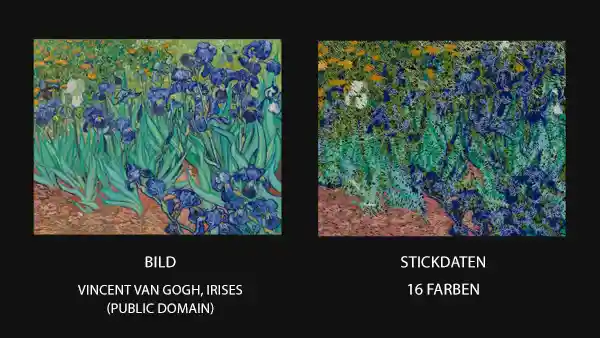
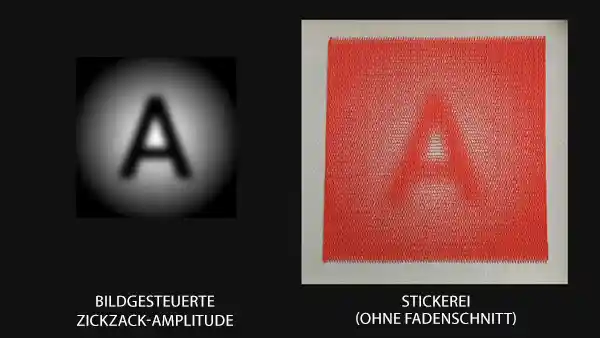
Image content can also be translated automatically into embroidery structures. Parameters such as contrast, crop, level of detail or colour impact can still be adjusted without rebuilding the entire process.
3D to embroidery
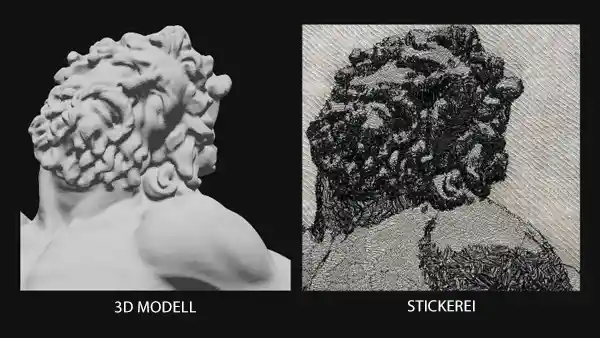
Nodety can integrate 3D content into the design process. Perspective, crop or object position can be changed while the resulting embroidery image is regenerated automatically according to the same underlying rules.
Automatic generation of optimised embroidery data
One of the key advantages of Nodety is its direct output into production-ready formats. This is not only about converting a design into an embroidery file, but also about the technical preparation for the production process.
Typical workflow advantages
- automatic stitch generation directly from the design process
- optimisation of stitch paths
- reduced points, potentially lower stitch count
- continuous stitch paths without additional manual editing
- export in ZSK Transportcode (.z00), DST and SVG
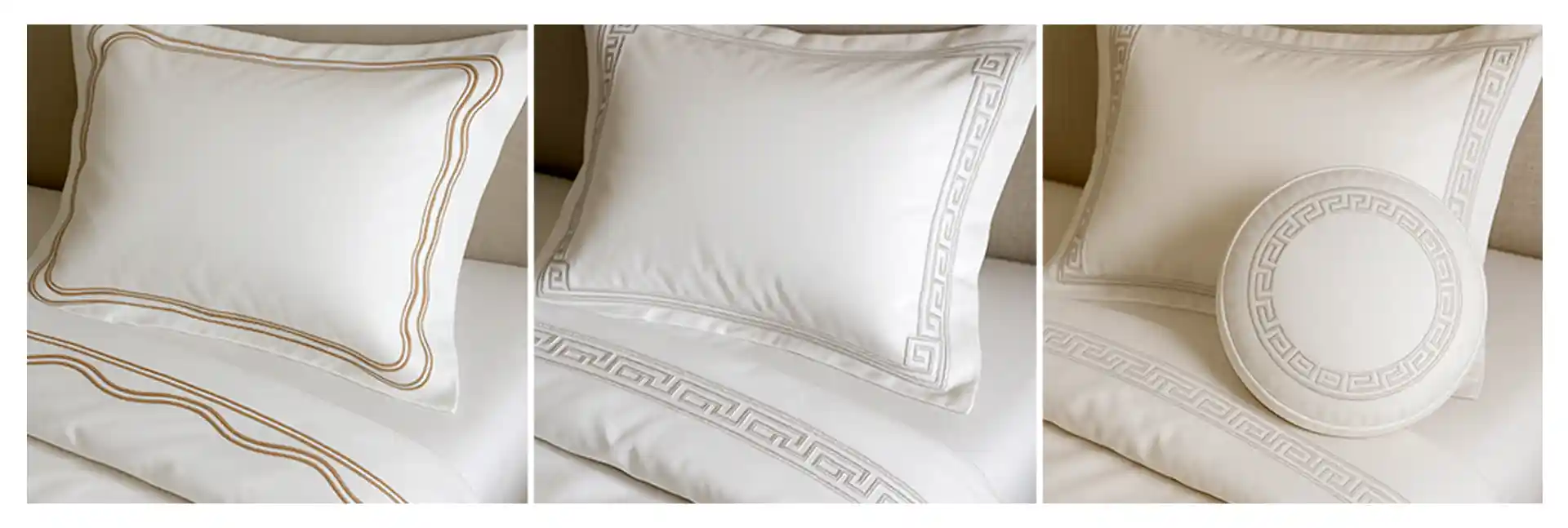
Even complex visual effects can be translated into embroiderable results using parameter-based logic. Brightness, gradients or blur can influence the structure and visual effect of the embroidery.
Production benefits for embroidery businesses
Faster creation of variants
Where content changes regularly, Nodety shows its strengths particularly well. A design system created once can be used for many variants without having to prepare each version manually.
Less repetitive manual work
Changes to text, perspectives, motifs or sizes are made directly within the existing project. This reduces repetitive editing steps and can significantly lower effort in standardised workflows.
Greater consistency in the result
Because parameters and relationships are preserved, variants are created using the same logic each time. This improves reproducibility and delivers greater consistency across multiple jobs.
Useful for personalisation and series production
Nodety is particularly useful for applications with recurring layouts, variable text, standardised logos or repeating design patterns. These are exactly the areas where the greatest friction often arises in practice.
Nodety speaks ZSK
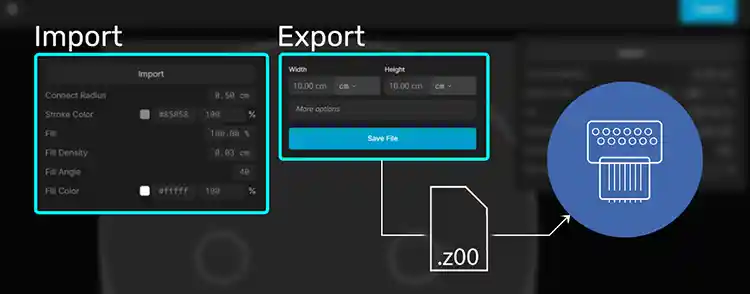
For ZSK users, direct compatibility is a key advantage. Nodety can write technical and production-related data directly into the ZSK transport code. This removes additional intermediate steps and conversions.
This shortens preparation time and creates a clear path from digital design to the embroidery machine. If desired, results can also be checked or further refined in BasePac.
Complements existing workflows instead of replacing them
Nodety is not intended to replace established tools, but to add another layer for parametric working and automated data generation. Especially in combination with existing ZSK workflows, it can open up new possibilities.
Possible workflow
Build design systems and variants in Nodety, adjust content, generate embroidery data automatically and then transfer it directly to production.
Optional fine-tuning
Where required, data can also be checked or refined further with the professional embroidery software BasePac. This keeps the existing workflow intact while extending it in a meaningful way.
Test instantly—no installation required.
Nodety runs directly in your browser, eliminating the need for local setup.
Getting started is effortless: once you register, you can dive right into the software, whether you're on Mac or Windows.
This is a major advantage for initial evaluations. You can explore the software’s full capabilities and workflow immediately, without any technical preparation.
Request a demo
Would you like to see how Nodety can be used in a ZSK-oriented workflow? Request your demo by email and test the software directly in the browser.
Nodety at a glance
A compact summary of Nodety’s key functions and application benefits:
- Creates from text, image and 3D directly an embroidery stitch file
- Parametric design instead of static files
- Real-time generation of embroidery data
- SVG to ZSK Transportcode (.z00) – automatic conversion
- Direct output for ZSK Transportcode (.z00) and DST
- Scalable for variants and series production
- Browser-based – no installation required
 Afrikaans
  Albanian
  Armenian
  Bosnian
  Bulgarian
 .svg) Chinese (Traditional)
Chinese (Traditional) .svg) Chinese (Simplified)
Chinese (Simplified)  Croatian
  Czech
Czech  Danish
  Dutch
Dutch  Estonian
  Filipino
  Finnish
  French
  Georgian
  Greek
Greek  Hindi
Hindi  Hungarian
  Indonesian
  Icelandic
  Italian
  Japanese
  Korean
  Latvian
  Lithuanian
  Malay
Malay  Maltese
  Macedonian
  Norwegian
  Polish
  Portuguese
  Romanian
  Russian
  Swedish
  Serbian
  Slovak
  Slovenian
  Spanish
  Tamil
Tamil  Thai
Thai  Turkish
  Ukrainian
  Vietnamese